20 Gbps Residential Internet: The PC Hardware You Actually Need to Avoid a Meltdown
Colorado's Pulse just rolled out symmetrical 20 Gbps home internet. Axel Reyes breaks down the PCIe, NVMe, and SFP28 hardware your PC needs before you...

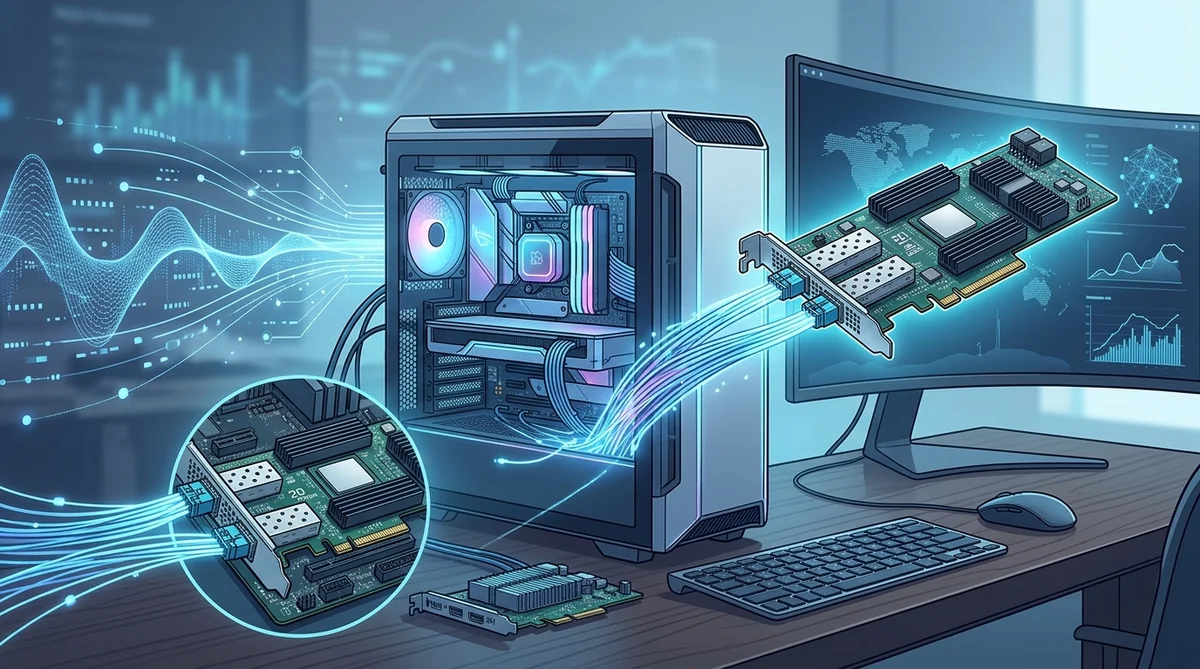
Table of Contents
- Loveland's Milestone: Vector Fiber Debuts Symmetrical 20 Gbps
- Network Architecture: 25G Enterprise Nokia Routers and SFP28 Optical Hand-offs
- The Desktop Bottleneck: PCIe Buses and NVMe Sustained Writes
- PCIe NICs and Managed Switches: Hardware Tiers to Protect Your Wallet
- Residential Breakthrough or Pure Overkill? Axel's Verdict
- Sources
The city of Loveland, Colorado, just shattered the ceiling for residential connectivity in the United States. Through its municipal telecom utility, Pulse commercially launched Vector Fiber, marking the state's first consumer internet tier capable of delivering symmetrical 20 Gbps straight into your living room. We are talking about an astronomical throughput: a theoretical 2,500 megabytes per second (2.5 GB/s) upstream and downstream.
That number looks jaw-dropping on a billboard, but beneath the marketing roll-out lies a brutal physical reality: your own PC. The vast majority of modern motherboards, integrated Ethernet ports, and even budget solid-state drives will choke long before they can swallow even a fraction of that incoming firehose.
Signing up for a datacenter-grade link makes zero sense if your desktop creates an instant bottleneck the second traffic hits your desk. Before you pull out your credit card to fund a connection of this scale, let's run the cold numbers. Here is the exact hardware you need so that massive pipe doesn't turn into wasted money on your monthly bill.
Loveland's Milestone: Vector Fiber Debuts Symmetrical 20 Gbps
Municipal operator Pulse framed this deployment as Northern Colorado’s next-generation performance benchmark. The engineering design leaves behind the legacy asymmetrical topologies typical of cable DOCSIS networks and conventional consumer fiber, where upload rates often dwindle to a tiny fraction of your download ceiling.
On this tier, the full 20,000 Mbps run unconstrained in both directions, free from monthly data limits or artificial peak-hour throttling policies. Pricing starts at $344 per month for subscribers enrolled in automatic ACH bank debit—or $349 per month with credit card billing. It is strictly priced and provisioned for advanced prosumers, homelab operators, and media production studios.
As detailed in the official press release published via Send2Press, the technical specs confirm: (anuncio oficial emitido a través de Send2Press)
- Bi-directional Throughput: Symmetrical 20 Gbps continuous pipe (2,500 MB/s theoretical raw transfer rate).
- Flat Residential Rate: $344/month via ACH debit, no contractual lock-ins, and zero data caps.
- Advanced IP Routing: Dedicated static public IPv4 address provisioned out of the box during deployment.
- Direct Engineering Support: Escalation path directly to municipal network operations center (NOC) engineers, bypassing standard Tier-1 call centers.
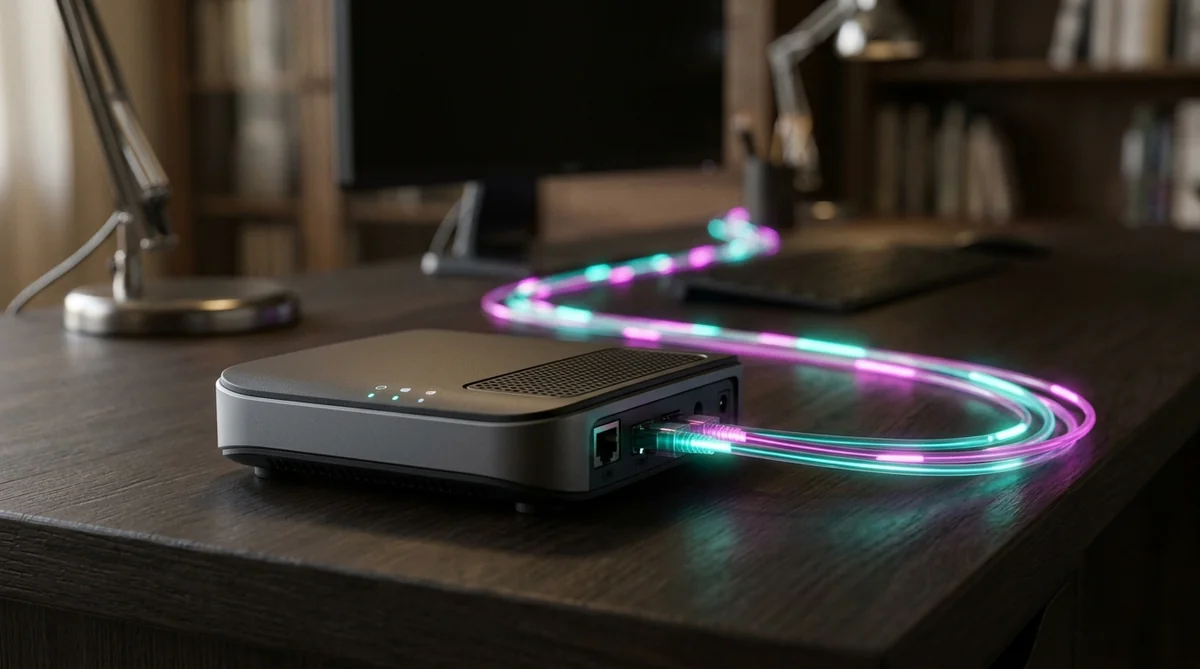
🎨 Conceptual reference illustration generated with AI. Does not represent the manufacturer's official design.
Network Architecture: 25G Enterprise Nokia Routers and SFP28 Optical Hand-offs
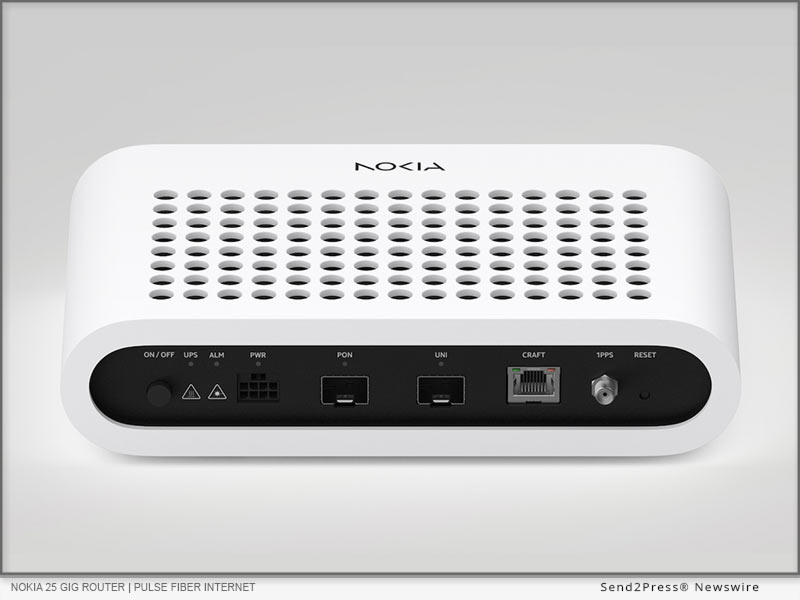
Pushing this tier of raw bandwidth into a private residence means ordinary copper twisted-pair cables with standard RJ45 modular jacks are dead on arrival at the demarc point. Pulse’s customer-premise hardware relies on carrier-grade 25G Nokia optical network terminals (ONTs), hardware developed for metropolitan telco transit rings rather than retail shelf space.
The service hand-off to your local gateway or core switch is delivered via a dedicated SFP28 transceiver cage. This industrial optical standard ensures packets transmit without added latency or cyclic redundancy check (CRC) errors, adhering strictly to the official IEEE 802.3by specification for 25 Gbps Ethernet.
Pulse Broadband Enterprise Director Brieana Reed-Harmel highlighted the operational target during the launch:
"Vector Fiber is ideal for residents who push the limits of what a home connection can do. Whether they're running a business out of their home, managing massive datasets, or developing the next breakthrough technology, 20 Gigs ensures they never hit a ceiling."
Make no mistake: this is not engineered for casual scrolling or streaming 4K Dolby Vision movies on Netflix. It is tuned for engineering workstations pushing multiple terabytes of transactional payload daily.
The Desktop Bottleneck: PCIe Buses and NVMe Sustained Writes
Here is where hard technical reality steps in. A 20 Gbps pipe translates to sustained real-world disk write operations at 2.5 Gigabytes per second (GB/s). Plug this connection into an everyday desktop, and your bandwidth will vanish along an internal chain of architecture bottlenecks.
The standard 1 Gbps Ethernet port (125 MB/s) on common motherboards can only ingest 5% of this pipeline. Even the 2.5 Gbps (~312 MB/s) adapters found on modern high-end gaming motherboards leave 87.5% of the connection unused. Similarly, mechanical hard drives or SATA III SSDs—which max out at 550 MB/s—will flatline the moment you attempt an unconstrained full-speed transfer.
For your rig to digest this stream, your network card must communicate directly with the CPU over robust interconnect lanes. According to the PCI-SIG bus throughput specifications, you need at least an open PCIe 4.0 x4 slot to handle full-duplex traffic exceeding 3 GB/s without choking processor communication or dropping frames.
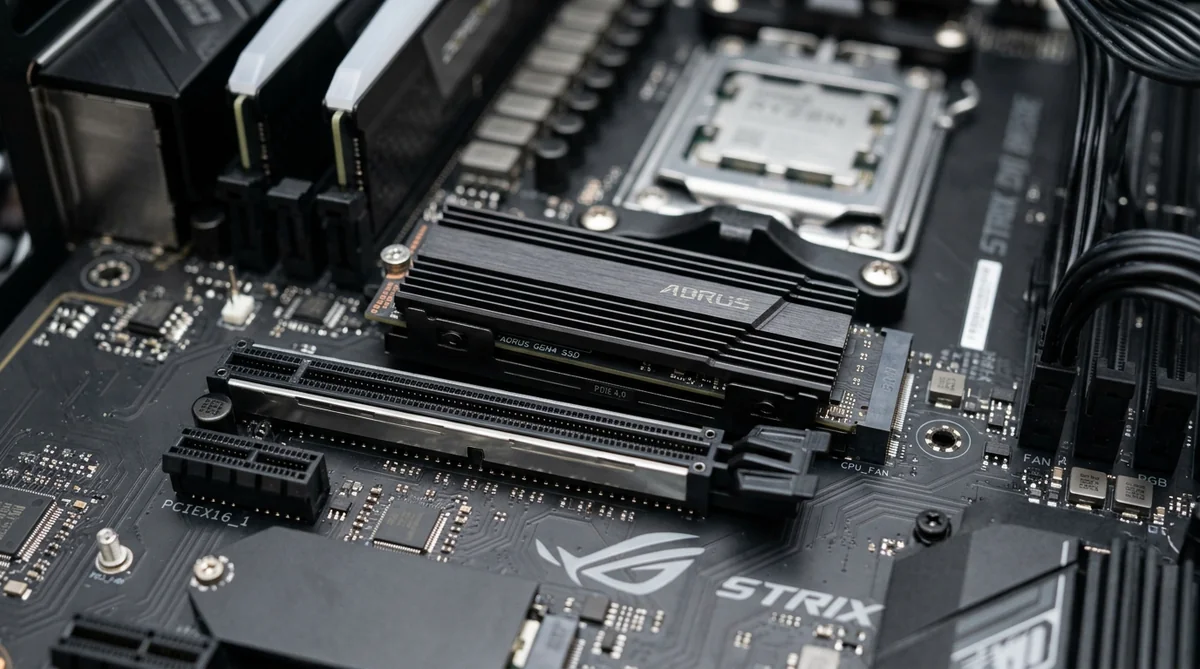
🎨 Conceptual reference illustration generated with AI. Does not represent the manufacturer's official design.
Your primary storage drive must also be a high-end M.2 NVMe PCIe 4.0 or PCIe 5.0 SSD backed by dynamic SLC caching and a competent controller. If your drive relies on low-tier QLC NAND flash or lacks a heavy aluminum heatsink, its sequential write speed will fall off a cliff due to thermal throttling within fifteen seconds of sustained ingest.
PCIe NICs and Managed Switches: Hardware Tiers to Protect Your Wallet
If you decide to sign up for the maximum speed outlined in Pulse's Vector Fiber service tier, the Nokia terminal installed in your garage is useless if your home network lacks optical transceivers. Your desktop demands a dedicated PCIe Network Interface Card (NIC) with an SFP28 25GbE cage, driven by enterprise controllers like the Mellanox ConnectX-4 Lx or Intel E810 (ficha de Vector Fiber de Pulse).
Unlike traditional consumer gear, this infrastructure connects through passive Direct Attach Copper (DAC) twinax cables for short runs or LC-duplex multi-mode OM4 fiber modules.
| Investment Tier | Core Hardware Required | Pipe Utilization | Primary Technical Trade-off |
|---|---|---|---|
| Entry ($) | 2.5GbE NICs and unmanaged switches | 12.5% (~312 MB/s per rig) | You waste 87.5% of your available bandwidth on a single machine. |
| Balanced ($$) | 10GbE NICs (Aquantia AQC107 / Intel X540) | 50% (~1.25 GB/s per rig) | Demands shielded Cat 6A copper lines and active cooling fans on PCIe cards. |
| Pro / Homelab ($$$) | 25GbE SFP28 PCIe NIC + Managed fiber switch | 100% (~2.5 GB/s dedicated) | Demands spare PCIe 4.0 x4 slots, DAC cables, and tuned OS Jumbo Frames. |
Stepping up to the 25GbE tier also means optimizing your operating system. You must install verified vendor drivers and enable 9000-byte Jumbo Frames. By enlarging the packet payload size from the legacy 1500-byte standard, you slash CPU interrupt requests (IRQs), keeping your processor cores from maxing out simply organizing network packet overhead.
Residential Breakthrough or Pure Overkill? Axel's Verdict
The numbers don’t lie, but ISP marketing certainly does. Getting 20 Gbps delivered to your home sounds like pure sci-fi bliss, but the broader internet cannot deliver data back to you at that velocity. Major content delivery networks, game platforms like Steam or PlayStation Network, and commercial cloud storage providers deliberately enforce per-connection rate limits to safeguard their own edge infrastructure.
Shelling out $340+ per month makes operational sense only if you manage an enterprise-tier homelab, synchronize uncompressed 8K RAW video pipelines with remote post-production facilities, or train local LLMs requiring multi-terabyte dataset ingest. For competitive multiplayer gaming, ultra-high-bitrate 4K streaming, or typical remote engineering workflows, a symmetrical 1 Gbps fiber drop remains more than enough headroom.
You don't need the latest shiny thing. You need what works for YOU.
📌 Importante
Before signing a contract for any multi-gigabit tier above 10 Gbps, audit your internal network fabric. If you lack optical transceivers, dedicated SFP28 switches, and open high-bandwidth PCIe slots on your PC, you are simply paying a hefty monthly premium for speed that will never make it past your utility closet.
Sources
- Send2Press Newswire: Pulse Launches Colorado's First 20 Gig Residential Internet Service — Official announcement detailing the Vector Fiber launch and Nokia 25G enterprise routing specifications.
- Pulse Fiber Internet: Vector Fiber 20-Gig Official Specification — Official service portal detailing symmetric 20 Gbps availability, SFP28 optical delivery, and tier pricing.
- IEEE Standards Association: IEEE 802.3by 25 Gb/s Ethernet Standard — Global networking standard governing physical layer and parameters for 25 Gbps Ethernet connectivity.
- Pulse Fiber Internet: Institutional Profile and Coverage Footprint — Municipal telecom utility overview and operational history in Loveland, Colorado.
Written by Axel Reyes
Tech & Hardware Editors
Personaje editorial y analista de Geekz News. Arquitecto de sistemas y entusiasta del hardware. Desmonta gadgets, evalúa benchmarks y traduce la jerga técnica a lenguaje que cualquier persona entiende. Axel no te dice qué comprar — te enseña a decidir por ti mismo con los datos correctos.
Thematic editorial persona backed by our human curation team.
Viral Desk Setup Gadgets: 7 Upgrades Actually Worth Your Money (and 3 Commercial Traps)
Nintendo Switch 2 Zelda Edition: Official MSRP, Confirmed Restocks, and How to Beat...